Prepared and open tunings on the classical guitar
Open tunings can really make a difference in how a piece is played. For years I have moved between early and modern music, from performance to composition, on several string instruments:
- Lute
- Theorbo
- Archlute
Their particular tunings and my curiosity pushed me to experiment, and the question I kept asking myself was:
How can I make a piece sound better on the guitar?
What sets the guitar apart: changing the tuning
The basic idea behind this practice is that on the guitar, unlike many other instruments, we can change the tuning quickly and practically.
The classical guitar, unlike the steel-string acoustic, has little history or literature of open tunings, because it was often snubbed by the great composers as a second-rate instrument.
At least four years of experience on the acoustic guitar let me get to know that repertoire, study what open tunings offer, practise them in the studio and in concert, and finally apply them to composition.
This experimentation opened up new musical scenarios, new horizons of sound and colour.
Pros and cons of open tunings
Every coin, unfortunately, has its flip side. The drawbacks I have found are practical ones:
- Gaps in live performance: with these tunings you get pauses while retuning for the next piece. This often bothers listeners who are already caught up in the mood of the music, which needs to flow without long interruptions.
- Tuning drift while the strings settle into the new tuning. You can get round this by using several instruments already set in their tunings. In concert I play two or three instruments with three kinds of tuning: standard, the lute tuning with the third string lowered a semitone to F♯ and often the sixth lowered a tone to D, and open G minor.
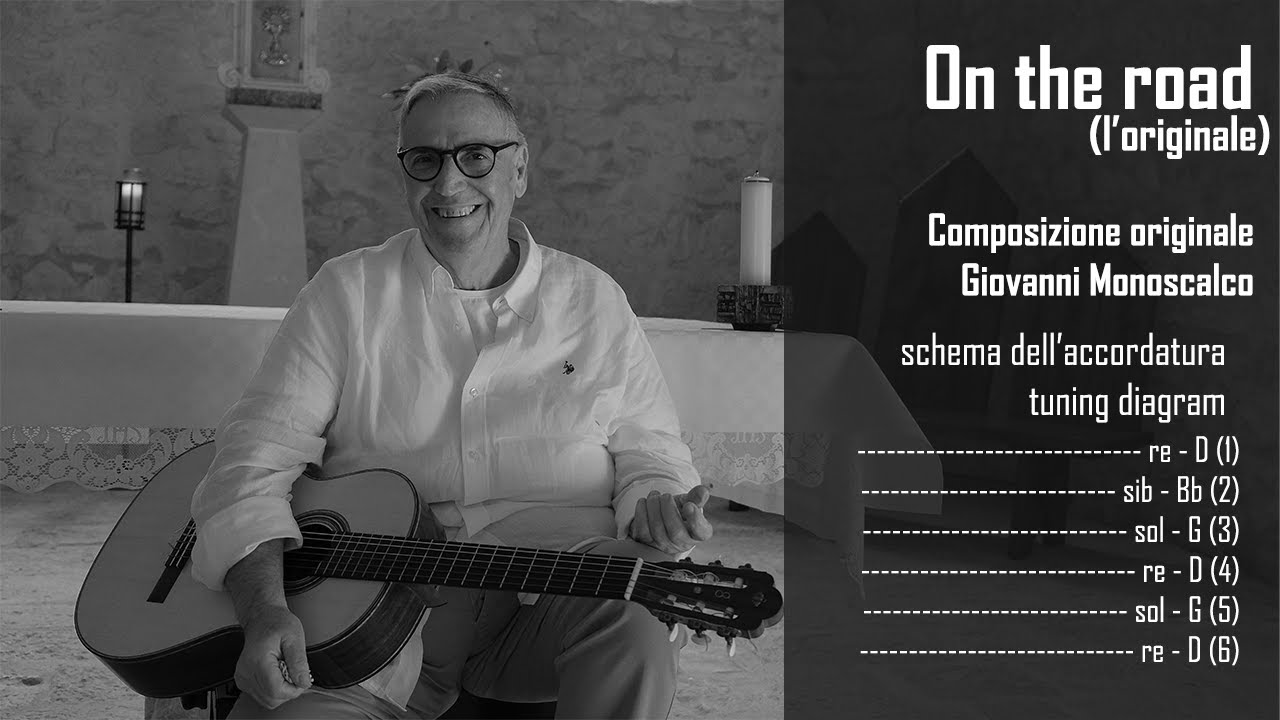
My first open-tuning composition: On the Road
My first composition in an open tuning is On the Road, a piece somewhere between ragtime and fingerpicking, written, naturally, right after and under the influence of the acoustic guitar. I discovered this tuning through a hero of my youth, John Renbourn, very close to my musical nature since he also cultivated early music: my style owes a lot to that influence. The piece that sparked my curiosity was «The Moon Shines Bright», from the beautiful album «The Black Balloon».
I wrote out the score of On the Road on a double staff, notation and tablature. For a practical example of how open tunings work you can download the first page of the score (PDF).